


One of the most common challenges in J1939 integrations is a speed mismatch between 250 kbps and 500 kbps networks. At first, the vehicle may appear to have a wiring issue, a bad module, or a diagnostic problem. But in many cases, the real issue is simpler: two systems are speaking the same J1939 language at different speeds.
What Does Communication Speed Mean in J1939?
J1939 is a communication protocol commonly used in heavy-duty trucks, buses, agricultural machinery, construction equipment, and industrial engines. It allows ECUs to exchange information such as engine speed, torque, coolant temperature, oil pressure, fault codes, and dashboard data.
However, not every J1939 network operates at the same baud rate.
Older heavy-duty platforms commonly use 250 kbps, while newer systems often use 500 kbps to support faster data refresh rates, more advanced emissions systems, additional sensors, and more complex electronic control strategies.
This creates an important compatibility issue: a 250 kbps J1939 network cannot communicate directly with a 500 kbps J1939 network.
Even if both systems use J1939, the speed must match for communication to happen correctly.
Why Speed Mismatch Happens
A speed mismatch usually appears when components from different generations or platforms are combined. This is especially common in engine swaps, fleet modernization projects, module upgrades, and custom vehicle integrations.
For example, a technician may install an engine ECU that broadcasts J1939 messages at 250 kbps into a chassis where the dashboard, instrument cluster, or body controller operates at 500 kbps. In that case, the engine may be sending valid J1939 data, but the dashboard cannot read it because it is listening at a different speed.
The opposite can also happen. A modern 500 kbps engine ECU may be installed into a vehicle where the cab network or dashboard still operates at 250 kbps. Again, the messages exist, but the two networks cannot understand each other directly.

Common Symptoms of a J1939 Speed Mismatch
A J1939 speed mismatch can look like many different problems. Some common symptoms include:
- Dashboard showing no valid engine RPM
- Missing torque, temperature, oil pressure, or battery voltage data
- Diagnostic scanner unable to communicate with certain modules
- Transmission module not receiving required engine information
- ABS or braking systems losing synchronization
- PGNs not being broadcast or acknowledged
- “No communication” symptoms even when wiring appears correct
- Valid CAN wiring but no useful data exchange between systems
These symptoms can lead technicians to replace components unnecessarily when the real issue is the communication speed.
How a 250 kbps to 500 kbps J1939 Converter Helps
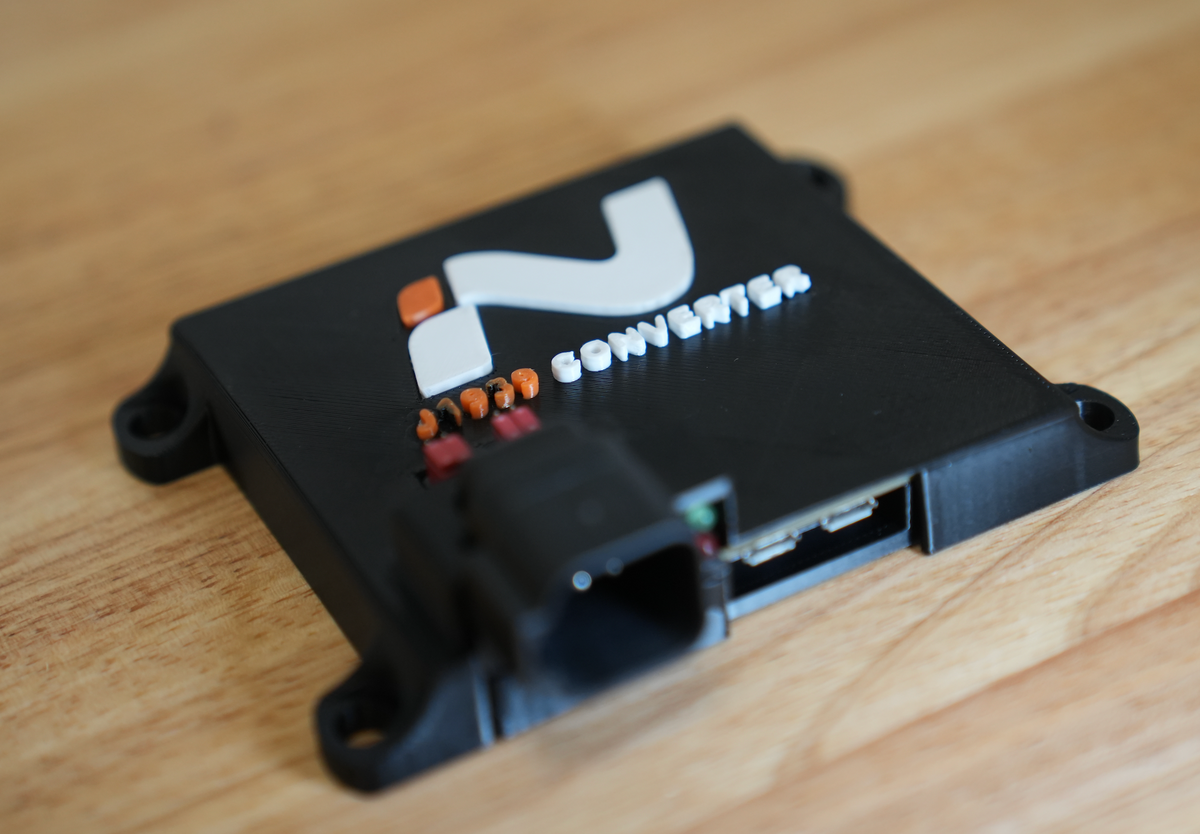
The INPRONIC J1939 250 kbps to 500 kbps Converter is designed to solve mixed-speed J1939 communication issues.
It works as an intelligent translator between two J1939 networks. One side connects to the 250 kbps network, and the other side connects to the 500 kbps network. The converter receives the incoming J1939 frames, validates them, reconstructs the message internally, and retransmits it at the opposite speed.
The key advantage is that the message content is preserved. The converter is designed to keep the original J1939 information intact, including the 29-bit identifier, PGNs, SPNs, priority, payload, diagnostic frames, and timing structure.
This allows two systems from different generations to communicate as if they were designed for the same network.

Important Installation Considerations
Before installing any J1939 converter, the technician should verify the communication speed on both sides of the system. The converter is designed specifically for mixed-speed systems, not for connecting two networks that already operate at the same speed.
Each network must also maintain proper CAN termination. A J1939 network normally requires proper impedance to avoid signal reflections, dropped frames, noise, incorrect PGNs, or complete communication loss.
It is also important to avoid connecting 250 kbps and 500 kbps CAN wires directly. Each side of the network should remain electrically isolated except through the converter.
The INPRONIC converter uses a 6-pin Deutsch-style connection that routes the 250 kbps CAN lines, the 500 kbps CAN lines, power, and ground. It is designed to operate when the key is turned on, making it suitable for vehicle integration where the device should activate with ignition power.
To verify the communication speed and understand the real CAN BUS network of your truck, INPRONIC design the CAN BUS Kit Pro Edition

Share:
Understanding OBD-II and J1939 Communication CAN BUS Multiplex Trainer